

The world heading into 2026 looks very different from a decade ago. New geopolitical tensions, trade disruptions, and surging energy demand — driven in part by AI and other energy-intensive industries — have countries scrambling to secure supply chains and shore up energy security.
And while fossil fuels remain in that mix, the larger story is the rapid acceleration of clean energy adoption and the strong flow of investment into markets building clean capacity. China and the EU have made clear that domestically produced clean electricity is central to their economic security. As a result, the clean economy is emerging as one of the world’s strongest engines of growth, with investment projected to climb from $5 trillion to $7 trillion over the next five years.
Canadians want to be among the winners in this new economy. And while concerns about climate change have dipped amid household financial stress, people still feel a responsibility to act. What’s shifting are questions about our competitiveness: Can Canada make the progress we need if our major trading partner moves in a different direction? And is it still true that the cleanest economies will be the fastest growing?
New survey research from New Economy Canada and Spark Insights explored these questions, including reactions to the recent federal budget. The survey was conducted online with 2,794 Canadians immediately following the November 2025 budget.
Over the next four weeks, we’ll contribute two more columns and share more detail from this research. As a scene setter, here is some of what we are seeing:
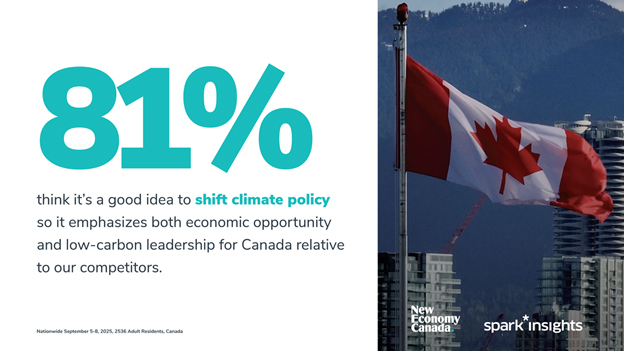
- 81% think it’s a good idea to shift climate policy so it emphasizes both economic opportunity and low-carbon leadership for Canada relative to our competitors.
- A majority (57%) believes that in 10 years’ time, “the cleanest economies in the world will also be the strongest economies”.
- When asked if they want federal policy to put more emphasis on a clean economy or a strong economy, a third (36%) say strong, a fifth say clean (21%), while the plurality (42%) chooses both.
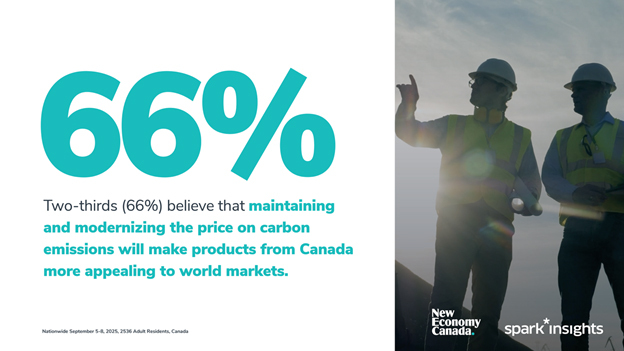
- Two-thirds (66%) believe that maintaining and modernizing the price on carbon emissions will make products from Canada more appealing to world markets because “they are made with sustainability in mind”. A third think it will make things harder for Canadian products because industries may face higher costs here.
As we see it today, public confidence in the path ahead is shaken but not reversed. Not long ago, agreement that “the cleanest will be the strongest” was closer to 85%. Recent political noise — particularly claims from Trump to the contrary — is creating uncertainty, making it harder for people to see the broader trends that felt obvious in the past.
Even so, most people still believe clean and strong go hand-in-hand, and they expect governments to prioritize both economic growth and environmental leadership as they navigate current challenges.
For those working to grow Canada’s clean economy, the imperative is clear: we need policies that are economically compelling, globally competitive and aligned with where markets are going, not where they’ve been. Equally important, we need to help Canadians understand the global trends shaping the future, so they continue to support the policies that will keep us in the race.
Canadians don’t want to trade economic growth for climate action. Fortunately, global trends mean they don’t have to. Clean growth is a winning strategy — for our economy, our competitiveness and for Canadians.
Merran Smith is President of New Economy Canada. [email protected]
Bruce Anderson is Partner and Chief Strategy Officer at spark* advocacy.
[email protected]