

What’s Canada’s secret weapon to supercharge our economy?
Something most of us rarely think about until it’s missing: electricity.
Affordable, reliable energy sits at the centre of how we live and work, and how our industries compete. That’s why it was encouraging to see the Prime Minister meeting with provincial and territorial premiers to talk about doubling the power grid, and making it net zero by 2050.
Why does this matter? Last year, China built more than three times as much electricity capacity as Canada has ever built, explicitly to give power-hungry industries low-cost, low-risk and low-carbon energy.
Canada’s electricity system is an outstanding asset as we navigate the economic rupture with the U.S., and we need to make sure it doesn’t become a bottleneck. To keep electricity affordable while meeting demand, we need to build an unprecedented amount of generation and transmission—whether it’s hydro dams, nuclear reactors, solar or wind farms, battery storage or gas plants — as we seek out new investment and diversify trade.
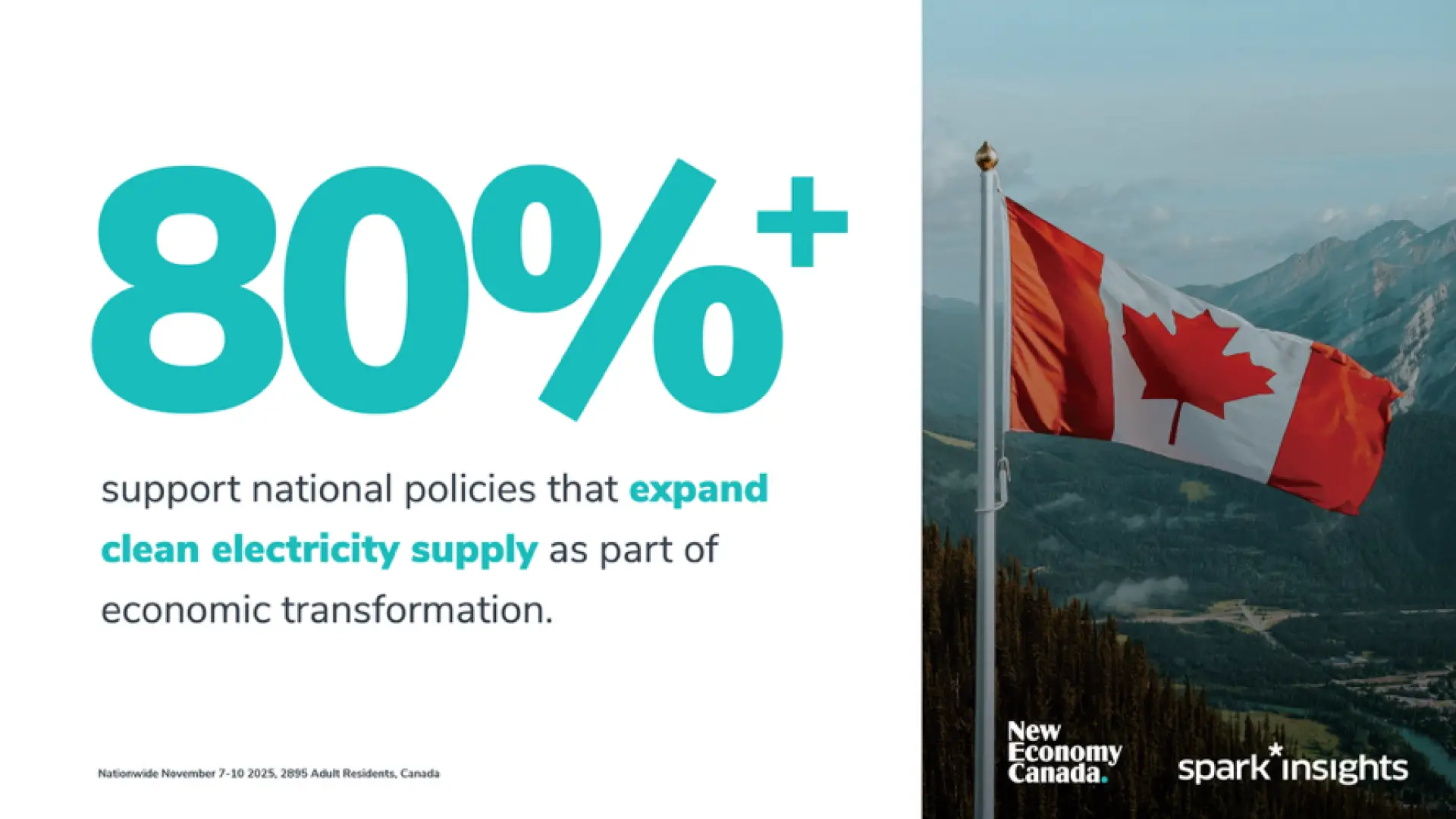
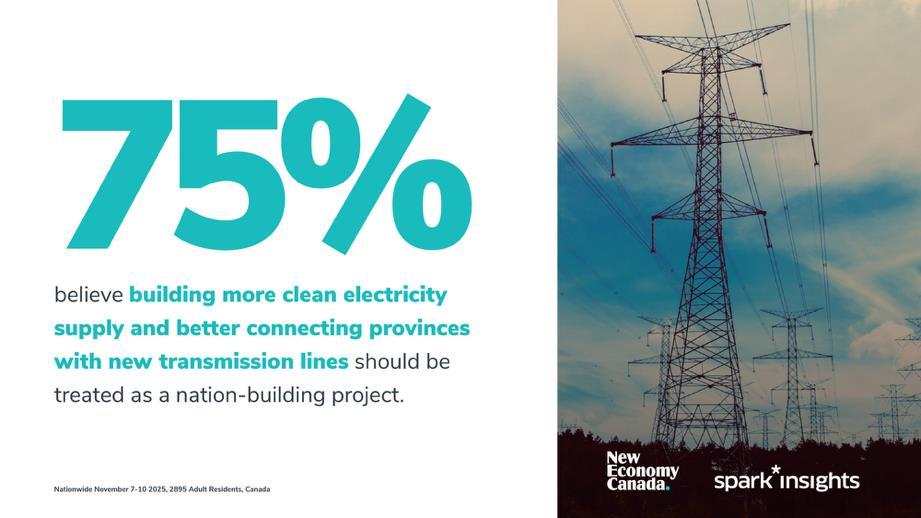
Canadians want to plan and build for the future — not fall behind. That’s why three out of four value a bigger, better and cleaner grid as a nation-building project.
Interest in more electricity supply is part of a burgeoning support for national initiatives that will strengthen and shape the Canadian economy.
Survey research from New Economy Canada and Spark Insights (2794 Canadians, online, November 2025) shows near universal agreement (88%) that this transformation is needed, a view that cuts across generations and partisan lines.
Canadians understand that electricity infrastructure can’t be taken for granted. Like railways, highways and communications networks, power systems shape where growth happens, which industries thrive, and how regions stay connected.
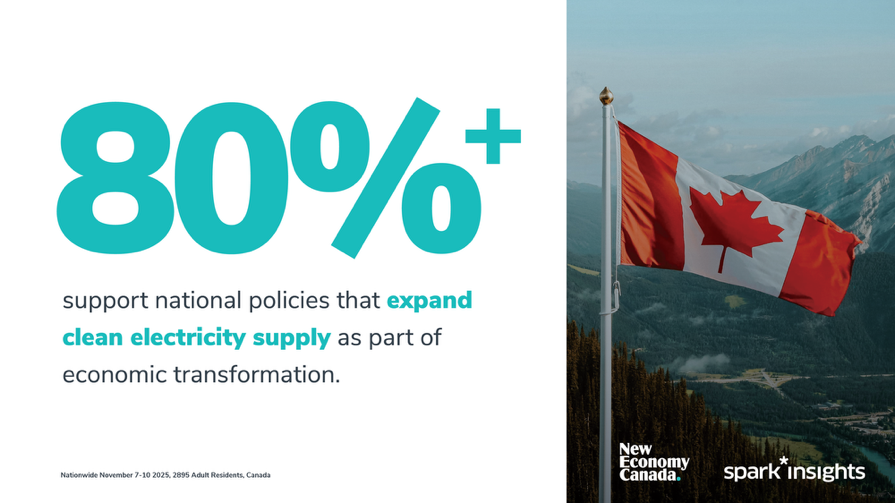
That’s why measures to expand clean power find huge (80% or higher) support.
This public opinion perspective is shared by businesses and communities planning long-term investments. In a world of growing electricity demand, geopolitical uncertainty, and extreme weather events, clean electricity is increasingly seen as a source of stability and the safest bet. That’s why the use of electricity is growing twice as a fast as overall energy demand and more than half of half of global energy investment is going to electricity.
Canadians value the role of clean power in addressing climate change, but their enthusiasm for a bigger, cleaner grid is also a practical calculation.
Whether it’s the peace of mind that comes from reducing reliance on volatile fuel markets, or saving money as solar and wind energy costs continue to decline, attracting industries that need more power and prefer low-carbon electricity, or keeping pace with other countries accelerating their investment in clean power, clean energy is both the right thing to do and the smart choice for Canadians.
Canadians see change as inevitable. Instead of fearing it, they want to plot a sensible course and stick with it.
In the months ahead, First Ministers will put more detail into the public square about how to deliver this big ambition. It will take a genuine team effort. For our part, New Economy Canada will convene a ‘roll up our sleeves’ approach, bringing together businesses, unions and Indigenous organizations with real experience in getting projects built and a shared commitment to delivering at the pace and scale the moment demands.
Canadians know we’ll need more energy and want governments to make the choices that reflect our values and economic realities. Growing clean electricity does both — and it’s the choice Canadians and companies are ready to commit to.
Merran Smith is President of New Economy Canada.
[email protected]
Bruce Anderson is Partner and Chief Strategy Officer at spark* advocacy.
[email protected]
The views expressed are those of the author(s). National Newswatch Inc. publishes a range of perspectives and does not necessarily endorse the opinions presented.