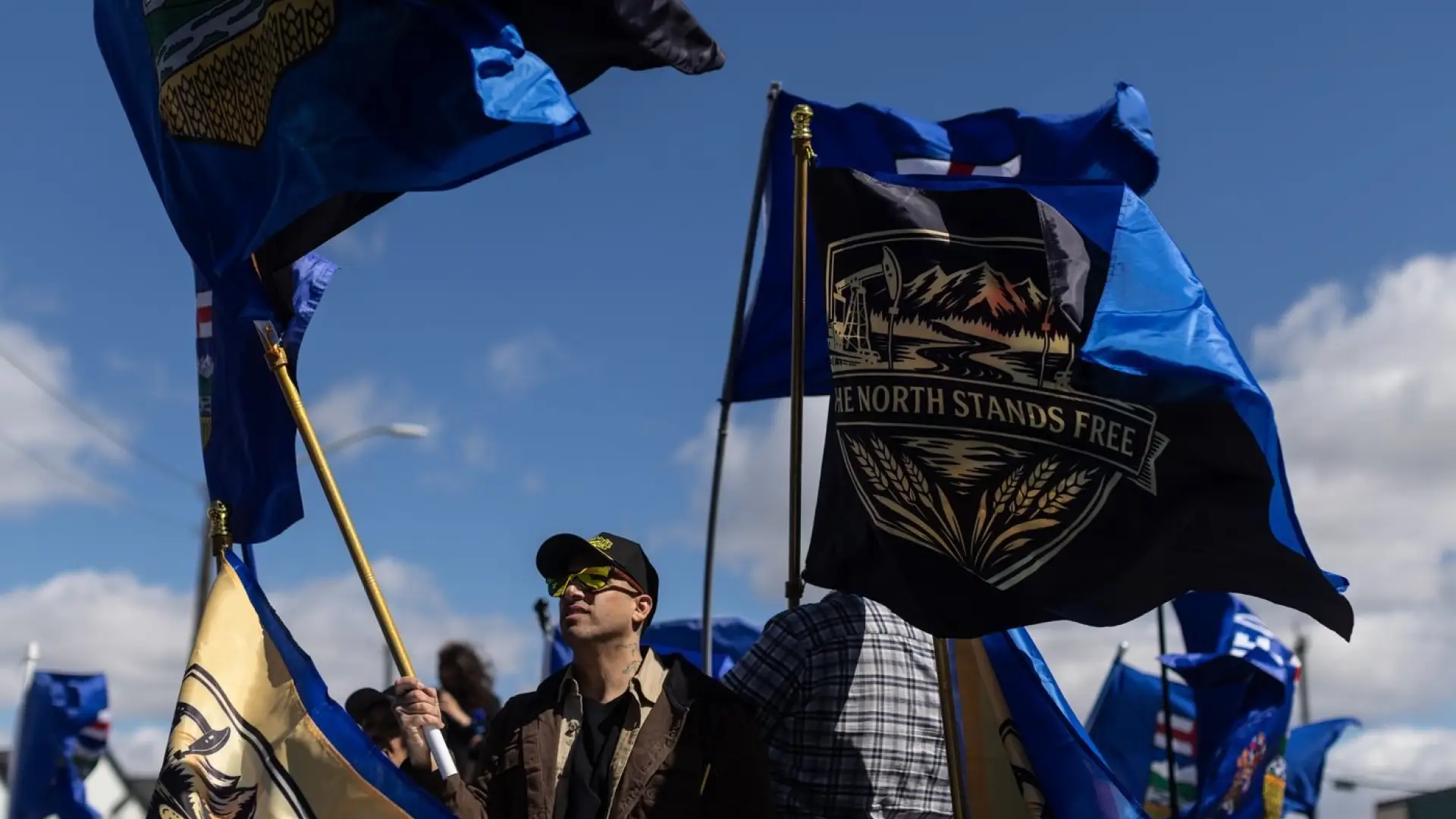
EDMONTON -- A judge threw out an Alberta separatist petition Wednesday, ruling the province had a duty to consult with First Nations — a decision quickly declared "anti-democratic" by Premier Danielle Smith.
Justice Shaina Leonard also said Alberta's chief electoral officer should never have issued the referendum petition.
The premier promised an appeal.
"This is a decision by one judge," said Smith. "We think that this decision is incorrect in law and anti-democratic, and we will be appealing it as a result."
Lawyers for several First Nations argued last month that Alberta's referendum process and its use by separatists is unconstitutional, as there's no requirement for Indigenous consultation. They also said separation would violate treaty rights.
Government lawyers defended the process and pushed for the separatist petition to play out.
"As a matter of logic and common sense, there can be no doubt that Alberta’s secession from Canada will have an impact on Treaties 7 and 8," Leonard wrote in her decision.
She said legislation passed in December amending the citizen-initiated referendum process "put in motion a series of required steps that engaged the duty to consult."
"No consultation occurred. Alberta breached its duty to consult with the applicants," Leonard said.
The legislation removed the requirement that proposed referendum questions be constitutional and the ability of the chief electoral officer to refer proposals to the courts for review.
It also allowed applicants to reapply if their proposals were still being reviewed by the time the bill took effect.
When the separatist group Stay Free Alberta first applied last summer for a petition, its question was referred to a judge for review.
That judge, the day after the bill was tabled, ruled the group's question was unconstitutional. The group reapplied, and its petition was issued in January.
Leonard said the separatists shouldn't have been allowed to reapply, because the chief electoral officer denied their first proposal Dec. 8. The legislation came into force three days later.
"The first proposal was not pending when the amendments came into force. It had been rejected and had come to an end," the judge said.
Allan Adam, chief of Athabasca Chipewyan First Nation, celebrated the ruling. The First Nation, along with the Blackfoot Confederacy, representing the Siksika, Kainai and Piikani First Nations, launched the case.
"This decision reinforces the importance of treaty rights, meaningful consultation, and the recognition of the serious impacts decisions like these would have on First Nations communities," Adam said in a statement.
"This decision should close the chapter on the suggestion of an independence referendum. The court has spoken — and so have the First Nations."
Piikani Nation Chief Troy Knowlton, who serves as president of the Blackfoot Confederacy, called the ruling a historic victory.
"Proceeding with an unconstitutional question would have caused irreparable harm to our Treaty rights," he said in a statement.
"The court has confirmed that those rights cannot be ignored, overridden or placed at risk by a citizen initiative or provincial referendum."
Smith said changes her government made to the petition process were meant to make it more permissible.
She also questioned the judge's ruling on the duty to consult, saying that obligation is usually reserved for special projects like pipelines.
Jeff Rath, a lawyer for Stay Free Alberta, said it would also appeal.
"We disagree fundamentally with the decision which appears on its face to violate the principles of natural justice and contain numerous errors of law," Rath said in a statement.
He added that Smith could simply call a referendum on separation, as "301,620 Albertans expect her to do so."
Stay Free Alberta handed in its petition last week, boasting that it had nearly 302,000 names — well above its 178,000 requirement.
Smith had said if the petition got enough signatures, the group's question would be put on a ballot this fall.
The premier and some of her cabinet ministers have said they support a sovereign Alberta within a united Canada but also believe in direct democracy.
Asked about demands for her to put separation on a ballot, Smith said she needs to discuss the judge's decision with her cabinet and United Conservative Party caucus.
Opposition NDP Leader Naheed Nenshi wrote off the possibility of Smith calling a referendum on separation on her own, telling reporters it would only land the government back in court again.
"They cannot do it without defying the law, without defying the courts and without knowingly doing something that is illegal. And guess what? The notwithstanding clause doesn't save her here."
Nenshi also criticized Smith for pandering to separatists, saying her refusal to condemn the movement has put her in a "political pickle," with much of her party's base now expecting her to call the referendum.
"If she wanted an escape route from this horrible pickle she built for herself, this (decision) is a great escape, and that is all the free advice I'll give to the premier today."
Other First Nations and Métis groups applauded the ruling Wednesday, with one chief warning that any attempt by Smith to bypass the court decision would be considered an attack on Indigenous people.
"Premier Smith is officially on notice," said Goodstoney First Nation Chief Clifford Poucette.
"There are no legal or political loopholes. We will not allow our rights to be ignored or erased."
Michelle Gurney with Elections Alberta said it needs some time to analyze the judge's decision and what it means for the future of the separatist petition.
Last month, Leonard ordered a pause on signature verification while she considered the challenge.
Lawyers for the province argued in court that it was premature to consult with Indigenous leaders about the petition, because the government wasn't yet taking action on Alberta leaving Canada.
They said if a referendum passed and the province took steps to follow through, then a duty to consult would be triggered.
During the hearing, the judge questioned why consultation wasn't done sooner, since First Nations have been sounding the alarm over the prospect of separation for more than a year.
The government's lawyers said it was a policy choice and that the province was within its rights to wait.
The premier has outlined nine questions dealing with immigration and constitutional changes for an Oct. 19 referendum, and a separation question going on the ballot was up in the air.
A pro-federalist petition has already been verified. Thomas Lukaszuk, a former Alberta deputy premier, spearheaded the "Forever Canadian" petition, which had just over 400,000 signatures verified by election officials in December.
This report by The Canadian Press was first published May 13, 2026.
— With files from Lisa Johnson
041